Your Hair Doesn't Have To Grow Back Before Your Part Can Look Fuller. Here's What Women 40–60 Are Using Instead.
The mirror is showing you a visual problem today — even if you're still deciding what, if anything, you want to do long term. Here's what changes under harsh light, why some coverage looks obvious, and what can make a widening part look fuller now.

For many women, the moment visible thinning becomes impossible to ignore is surprisingly specific: a bathroom light, an elevator mirror, or a candid photo taken from slightly above.
The change may have been gradual — a thinner ponytail, more scalp showing through the part, more time spent checking angles — but harsh overhead light makes the contrast feel sudden.
That moment matters because the immediate problem in the mirror and the long-term biological question are not the same job.
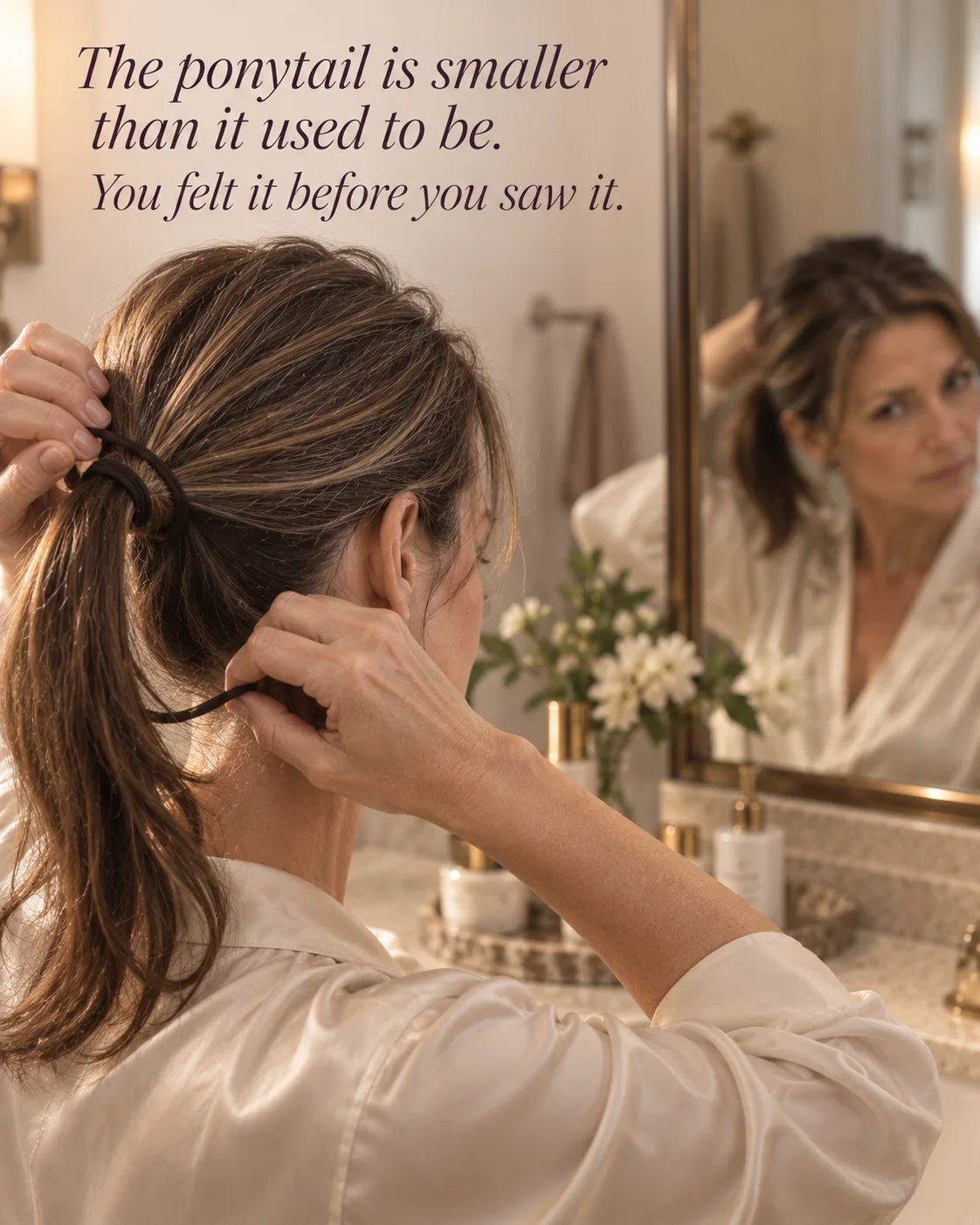
Across hair-loss communities and customer research, the same pattern comes up again and again: visible thinning starts to quietly reorganize the day.
You notice where the overhead lights are. You check the camera angle before a video call. You think about wind, restaurant seating, photographs, and whether someone standing behind you can see the part you keep checking.
The deeper frustration is not simply wanting more hair. It is wanting the problem to stop taking up so much mental space.
Once you notice that pattern, one distinction becomes especially useful: a long-term biological plan and today's visual problem are not the same job. One may take months to evaluate. The other is visible in the mirror this morning.
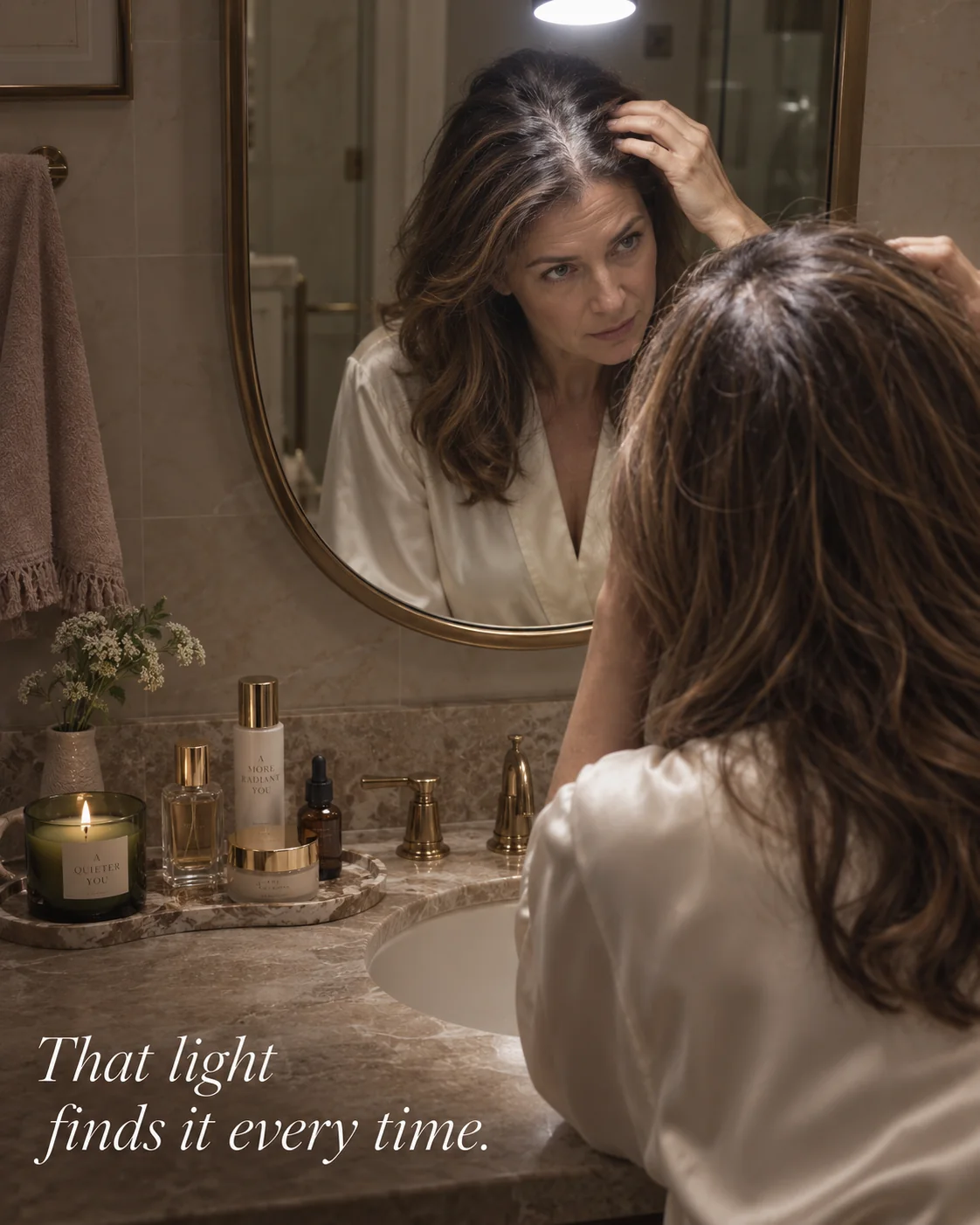
There's a specific reason your part can look dramatically more visible under certain lighting. Once you understand what's making the contrast look stronger, the solutions that make sense can look very different from the ones you may have tried before.
Let's go through what you need to know.
What you're seeing in the bathroom mirror probably isn't what you think it is — and that reframe matters.
At first glance, it can feel as though a significant amount of hair is simply gone. For many women with diffuse thinning, though, part of the visible change can also come from individual strands becoming finer.
Hormonal shifts around perimenopause and menopause can coincide with progressively finer hair. Even when plenty of hair remains, finer strands can provide less visual mass than they used to.
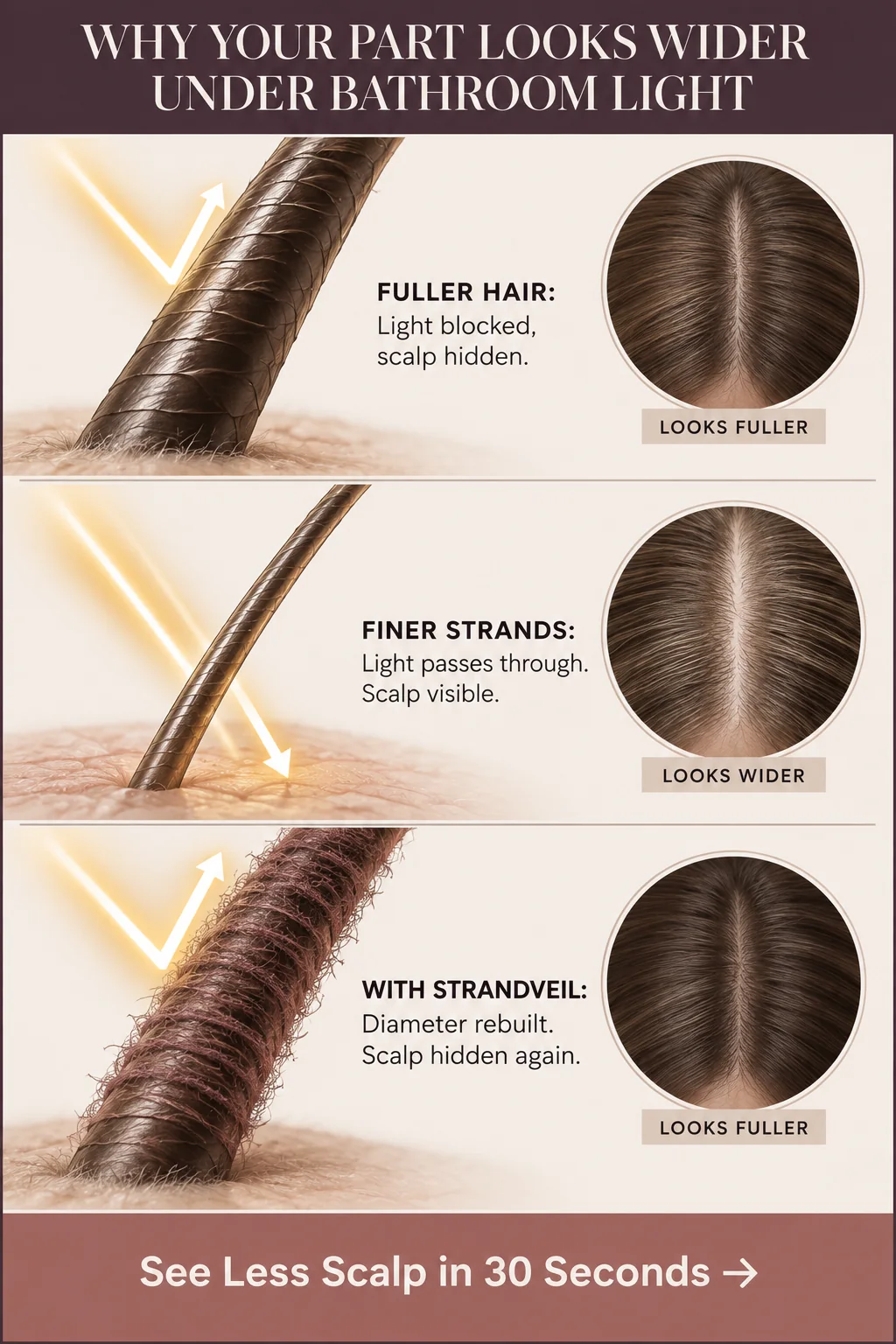
Thicker strands block light. Finer strands let it through.
When strands become fine enough, they no longer create the same visual coverage across your part. More light reaches and reflects from the scalp beneath them, so the eye — and the camera — sees stronger contrast between hair and scalp. Think of this as the scalp-contrast gap: our shorthand for the visual difference between your hair and the scalp showing through it.
This is why a woman can still have plenty of existing hair and yet see much more scalp than she used to. It's not a contradiction. The immediate visual problem can be one of coverage and contrast — even while the underlying cause of thinning is a separate question.
Understand why bathroom lighting specifically is doing this to you — it's not arbitrary.
You've probably noticed that your hair looks more or less okay in some light and catches you completely off guard in others. Bathroom mirrors, changing rooms, office restrooms, elevator reflections. The pattern is consistent — and it's not random.
Overhead downward-cast fluorescent or LED lighting illuminates the top of your head at a near-vertical angle. That angle maximizes the contrast between the bright scalp below and the hair above it. There's nothing to cast shadow depth into the part, nothing to give the strands visual weight. The scalp-contrast gap appears at its absolute starkest.
Natural light from a window, or light that comes from the side at an angle, creates shadows within the hair that add perceived density and depth. The same contrast gap that reads as alarming under a bathroom light often reads as barely noticeable in morning light.
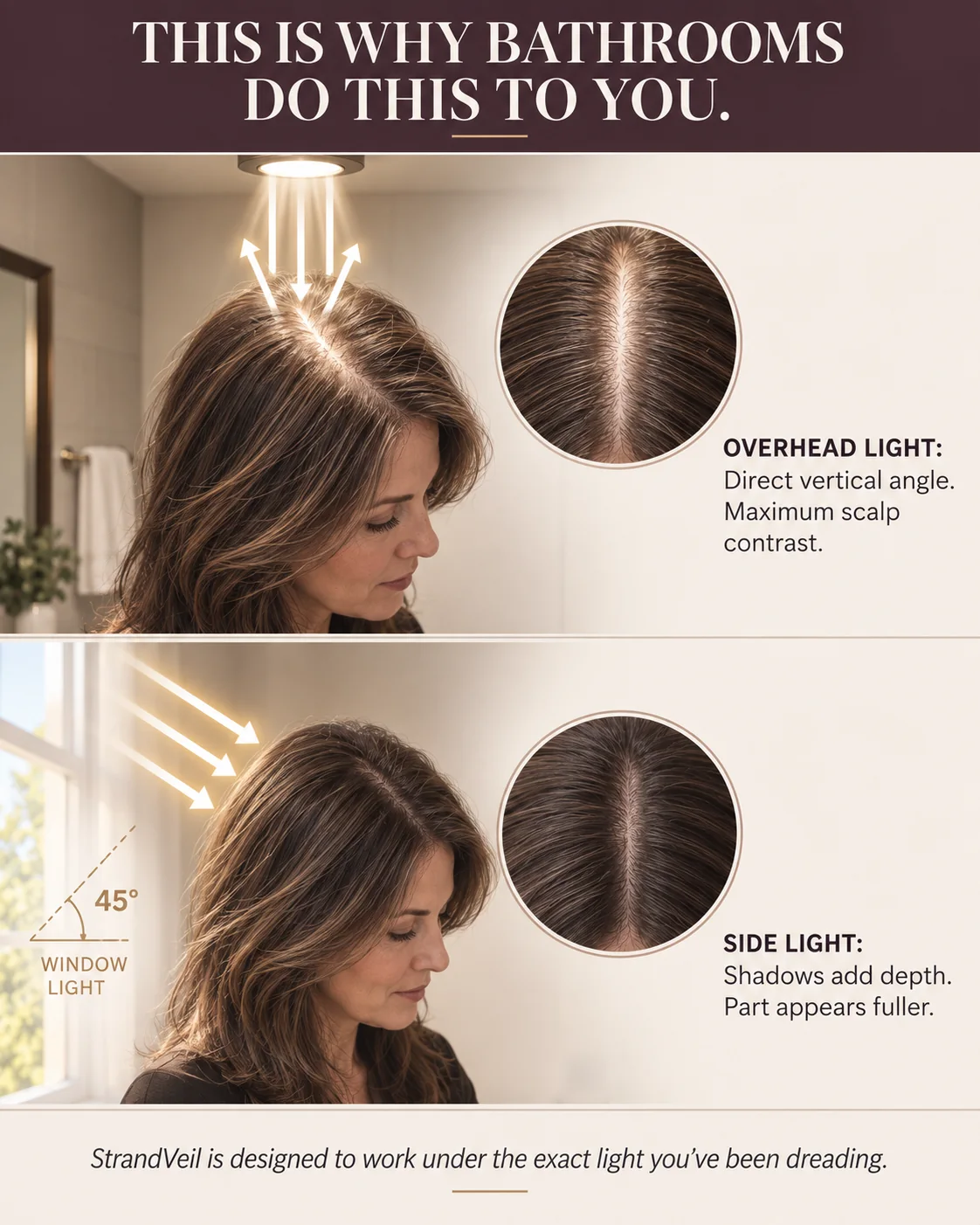
This is also why candid photos can produce that same shock — an overhead flash or a camera held above eye level hits the part at the same angle a bathroom ceiling light does.

The version you're seeing in the bathroom mirror is specifically exaggerated by that angle of light. It's the worst-case view. And closing the scalp-contrast gap — reducing what the eye actually perceives — is a more solvable problem than what that worst-case reflection sometimes implies.
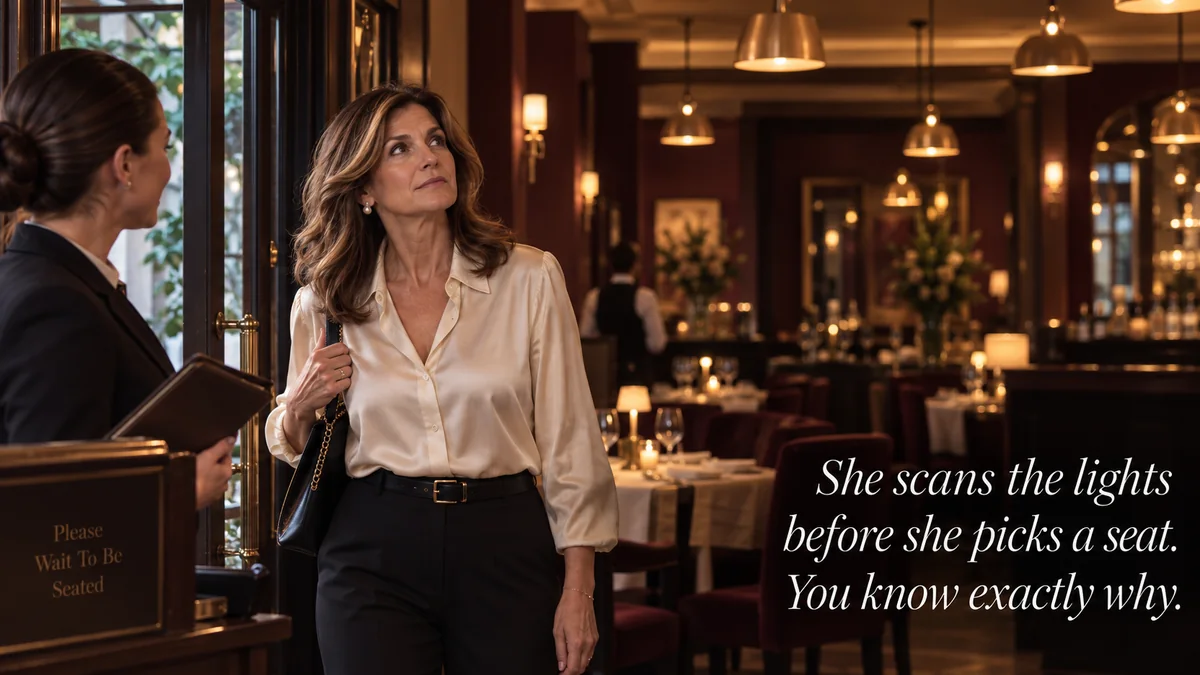
Tonight’s visual problem and the long-term biological question are two different jobs on two different timelines.
There's a mental loop a lot of women get caught in, and it's worth naming directly.
I should be treating the root cause, not masking it. Cosmetic solutions are giving up. If I'm serious about this, I need to pursue biological regrowth and not settle for anything short of that.
This sounds like discipline. In practice, it can mean spending months evaluating supplements or considering treatments such as minoxidil while worrying about the possibility of an initial shedding phase — and in the meantime, having nothing for the dinner this Saturday, the photos at your friend's daughter's wedding, or the work presentation under fluorescent light that you've been quietly dreading.
The biological and the cosmetic are separate problems operating on completely different timelines. They are not in competition. Pursuing a long-term treatment plan doesn't prevent you from wanting your part to look better before you leave the bathroom this morning.
You are allowed to want a result today, even if you're also working toward something in six months.

Once you separate those two timelines, it becomes easier to judge cosmetic coverage on its own job: how your hair looks today.
Why so many root sprays and scalp powders look obvious under harsh light — and what works differently.
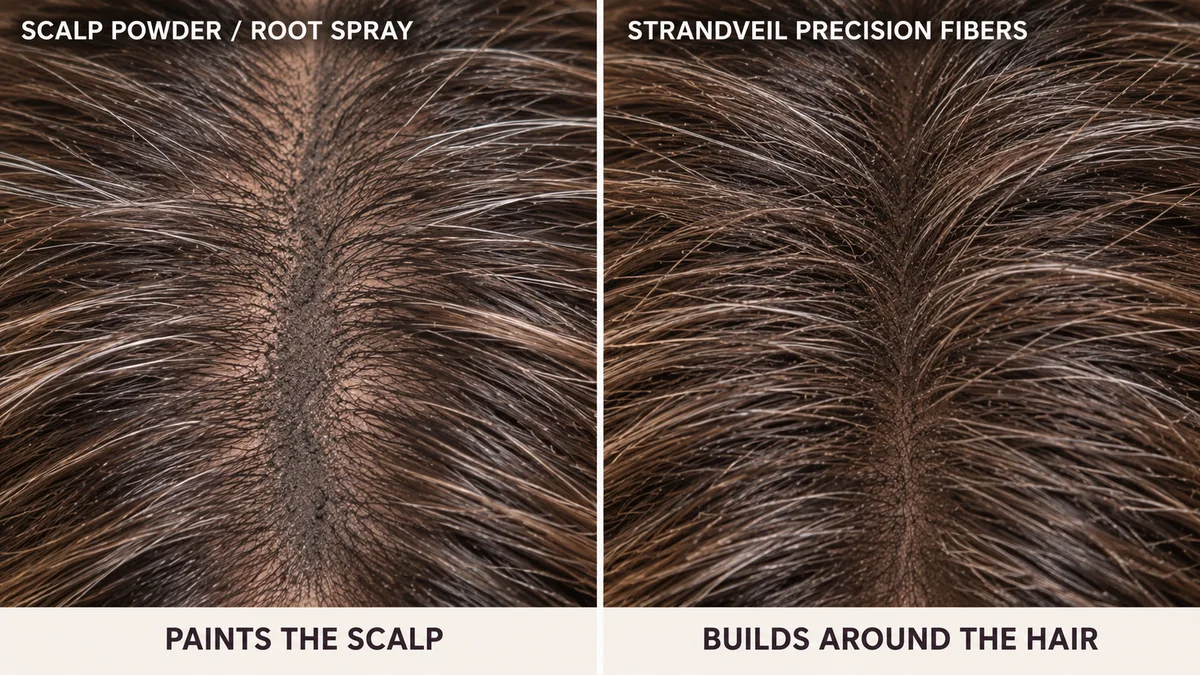
If you've tried root sprays, tinted dry shampoos, or scalp powders and found them more frustrating than helpful, one common limitation is where the product sits: broadly on the scalp rather than among the existing strands you want to look fuller.
Root sprays and powder-based products generally work by coloring the scalp to reduce contrast with the hair above it. Under close inspection or bright light, pigment sitting on skin can still read differently from hair. Depending on the formula and application, it can also transfer to hands, pillowcases, or collars because the pigment is sitting on a surface that contacts other surfaces throughout the day.
Hair-building fibers work differently — and the reason comes down to a basic physics principle most people have already seen without realizing it.
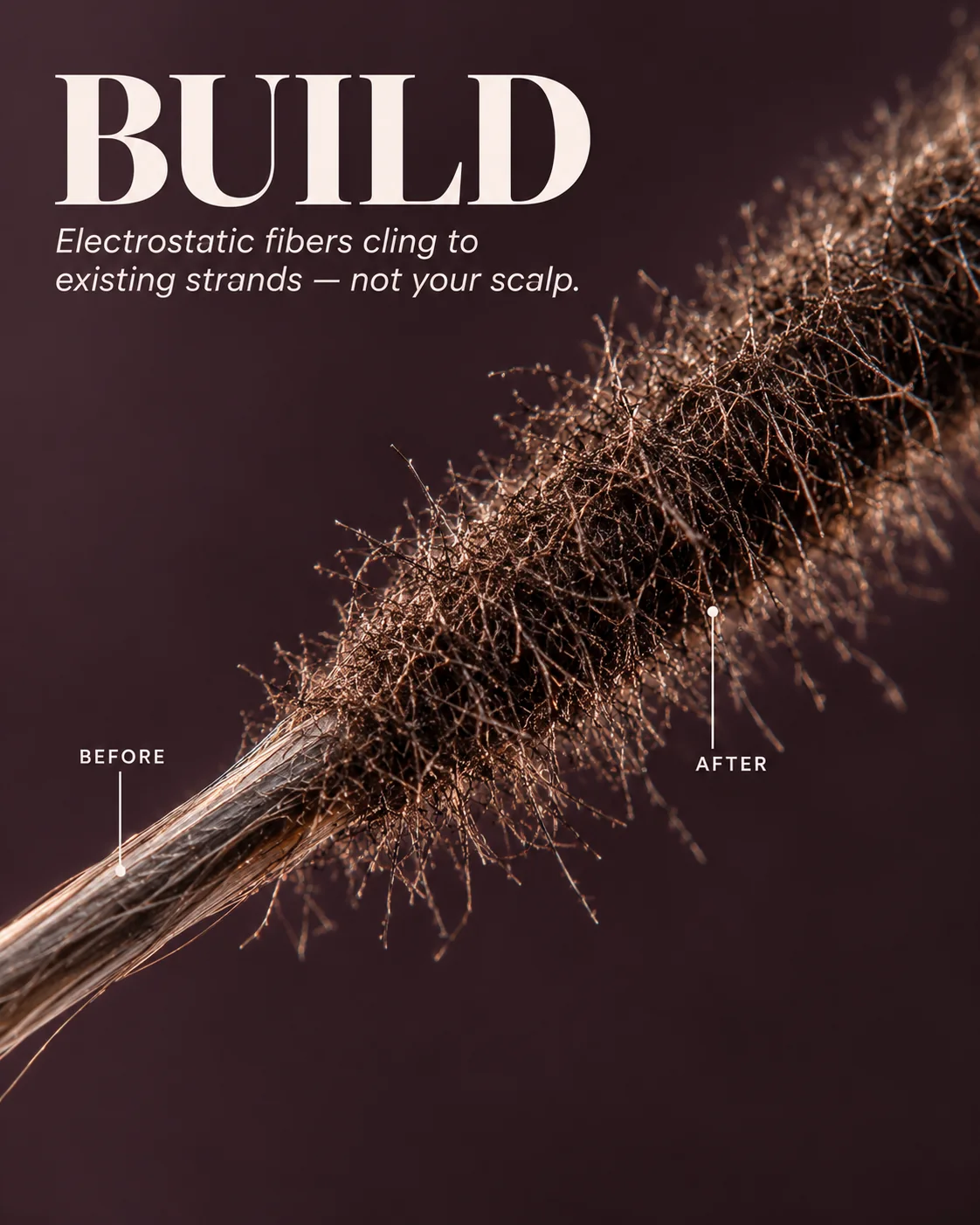
You've watched a balloon rubbed against fabric attract and hold individual hairs. That same effect is what makes fiber-based coverage function differently from pigment on skin. Hair carries a natural static charge. Keratin fibers carry the opposite charge. When fibers are directed toward existing strands, they're drawn to the hair itself rather than falling through to the scalp below — they wrap around the shaft and increase its apparent thickness, which reduces how much scalp the eye perceives between strands.
This is why the result can read as fuller-looking hair rather than powder sitting visibly on skin. The fibers aren't on the scalp. They're on the hair.
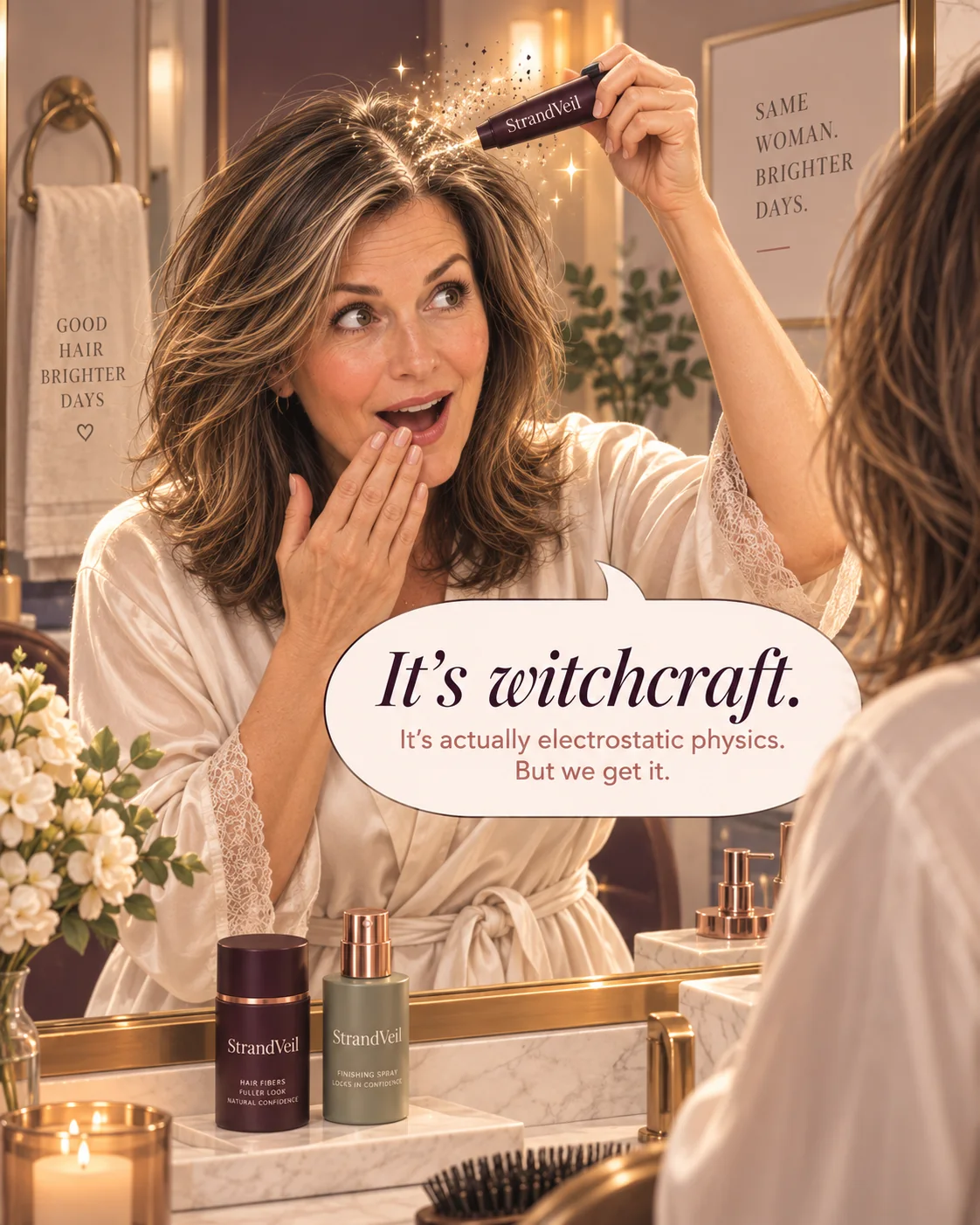
Under direct overhead light, the goal is a finish that reads as fuller-looking hair rather than a visibly covered scalp. That distinction matters most in the exact conditions that tend to trigger the most scrutiny: bright bathrooms, phone cameras, and close conversation.
What natural-looking coverage actually requires — and why application matters.
The deepest fear most women have about cosmetic hair coverage isn't whether it works mechanically. It's whether it holds up at the moment that counts most — when someone is standing close, or a camera finds the wrong angle, or a gust of wind moves the hair and exposes whatever is underneath.

For coverage to look believable up close, three things need to work together.
The right format — fine hair-building fibers that integrate with existing strands instead of relying on a flat layer of pigment on the scalp.
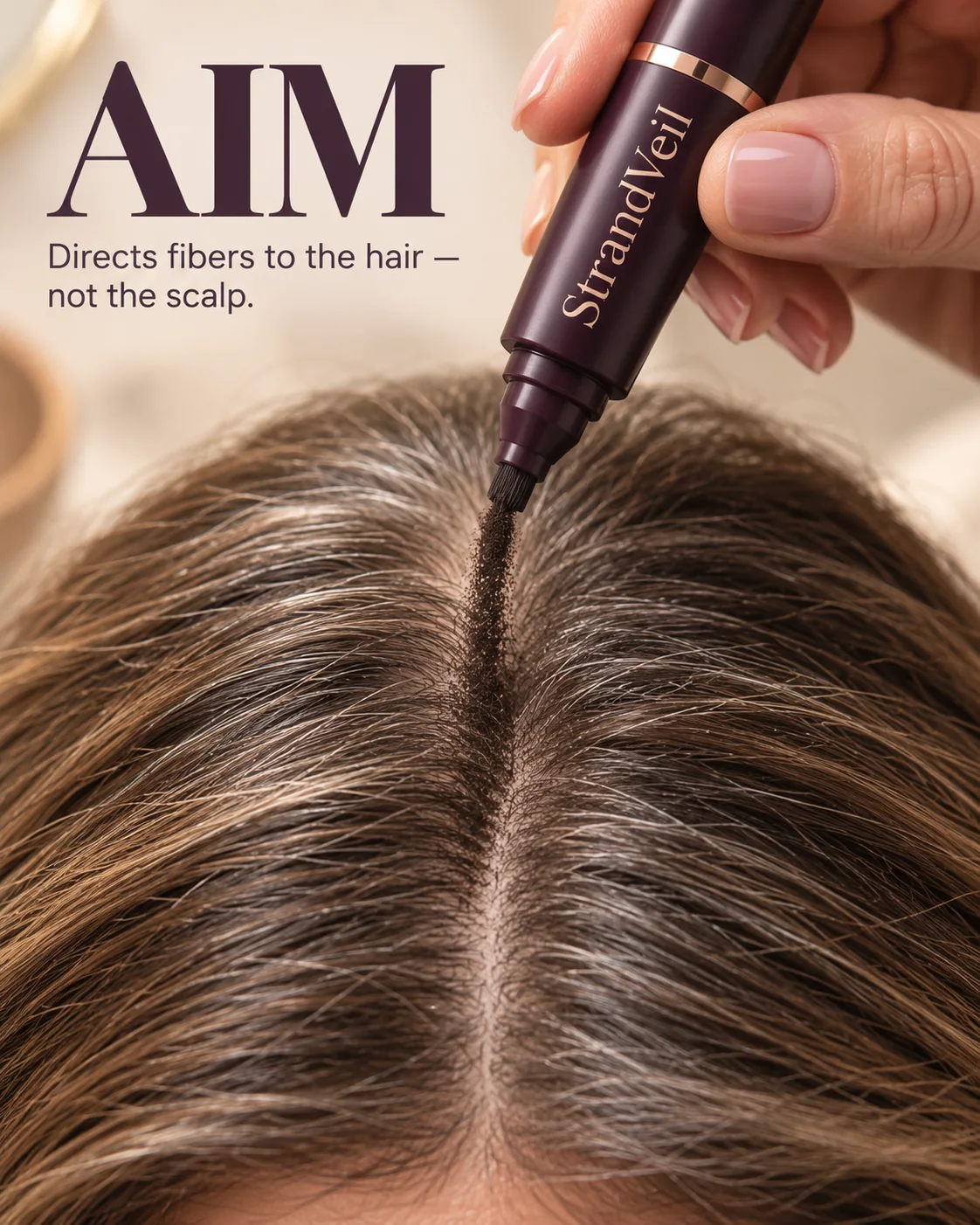
Precise placement — directing more of the fiber toward existing hair instead of broadly dusting the entire area. With loose shaker application, some fibers can land on hair and some on skin. The more product that sits on skin, the more likely the finish is to read like visible powder at close range. Precision also helps keep the application contained instead of scattering product across the counter.
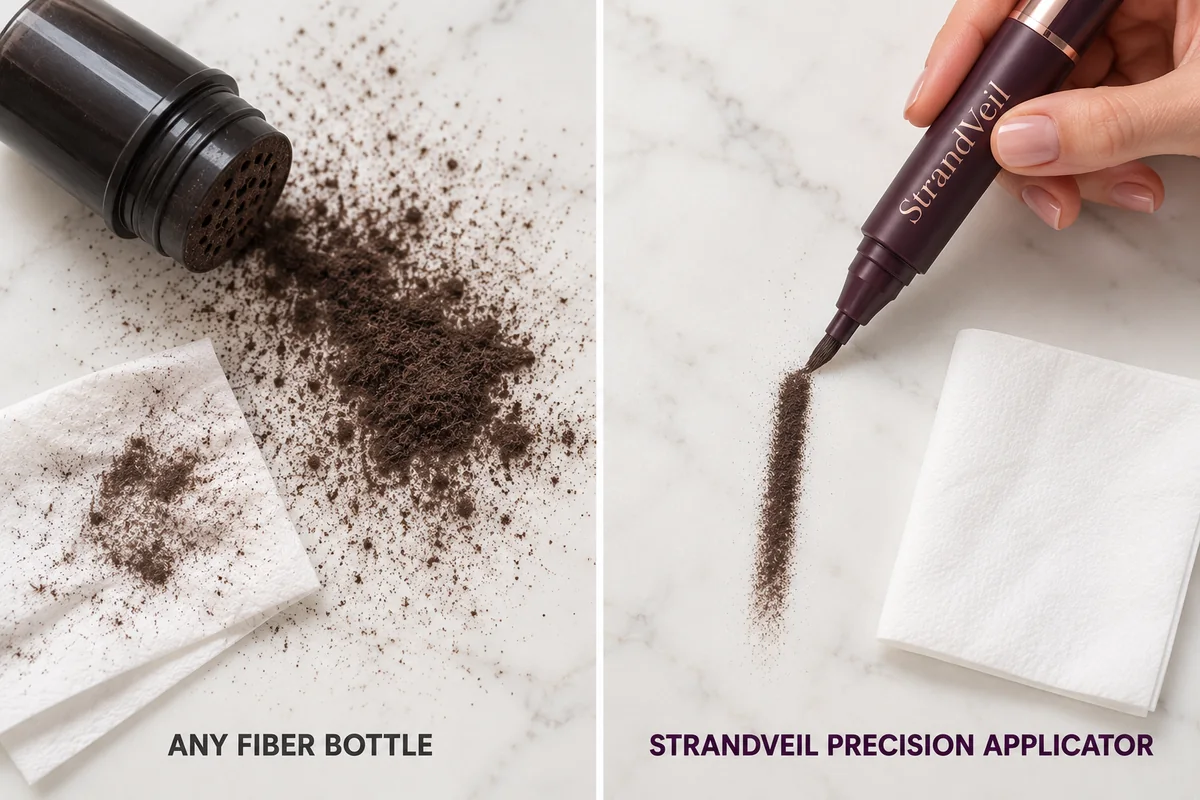
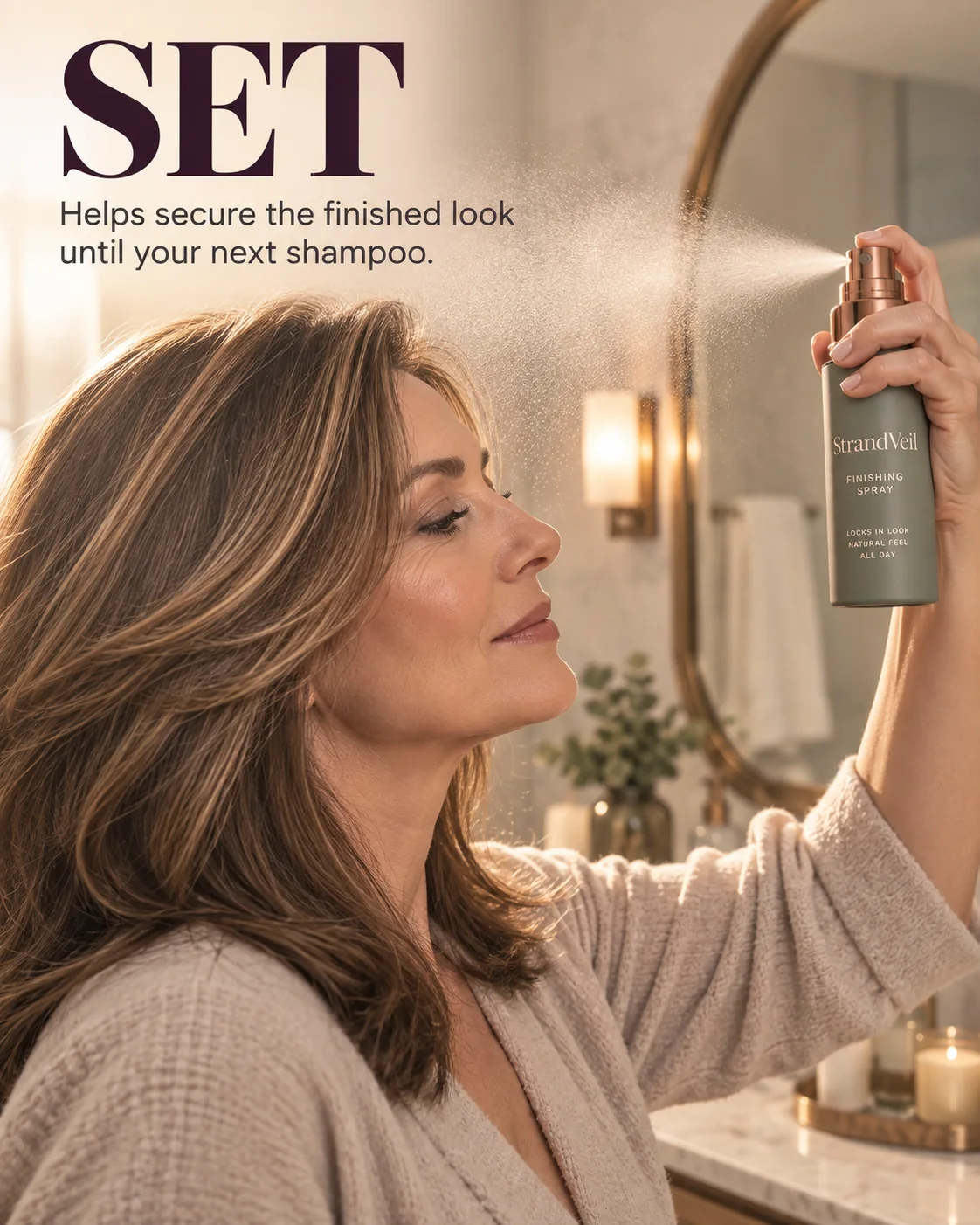
A setting step — something designed to help secure the finished coverage and reduce loose-fiber movement during normal daily wear.
When all three are present, the result is designed to look more believable under the situations that matter most: bathroom lighting, restaurant ceilings, phone-camera distance, and everyday movement.
It also doesn't require salon skill. A first application may take a little longer while you learn how much product you need, but the routine itself is intentionally simple.
Before we get to the product, one thing is worth saying clearly.
There is a specific exhaustion that comes from having this experience dismissed by people who aren’t having it. The dermatologist who gives you four minutes and a pamphlet about stress management. The partner who says “I can’t even see it” — which is somehow worse than if they could, because at least then the problem would be real. The colleague who says “your hair looks completely fine” in a tone that ends the conversation before it starts. What every one of these moments has in common is that the person saying it has nothing at stake in your bathroom mirror every morning. You do. The distress you feel is not vanity. It is what happens when something that used to be reliable about your body is no longer reliable, and the people closest to you have no way to understand why that matters as much as it does.
There is a second version of this frustration. Every product that gets recommended was built for a different problem. The major fiber brands spent decades marketing to male vertex baldness — the shiny crown, the receding hairline. A widening part in a woman’s hair is structurally different from male pattern baldness. The coverage need is different. The emotional context is completely different.
What I was looking for was something built for this problem from the beginning. Not adapted, not repositioned. Built specifically for the widening part. Built for the scalp-contrast gap. Built for women.
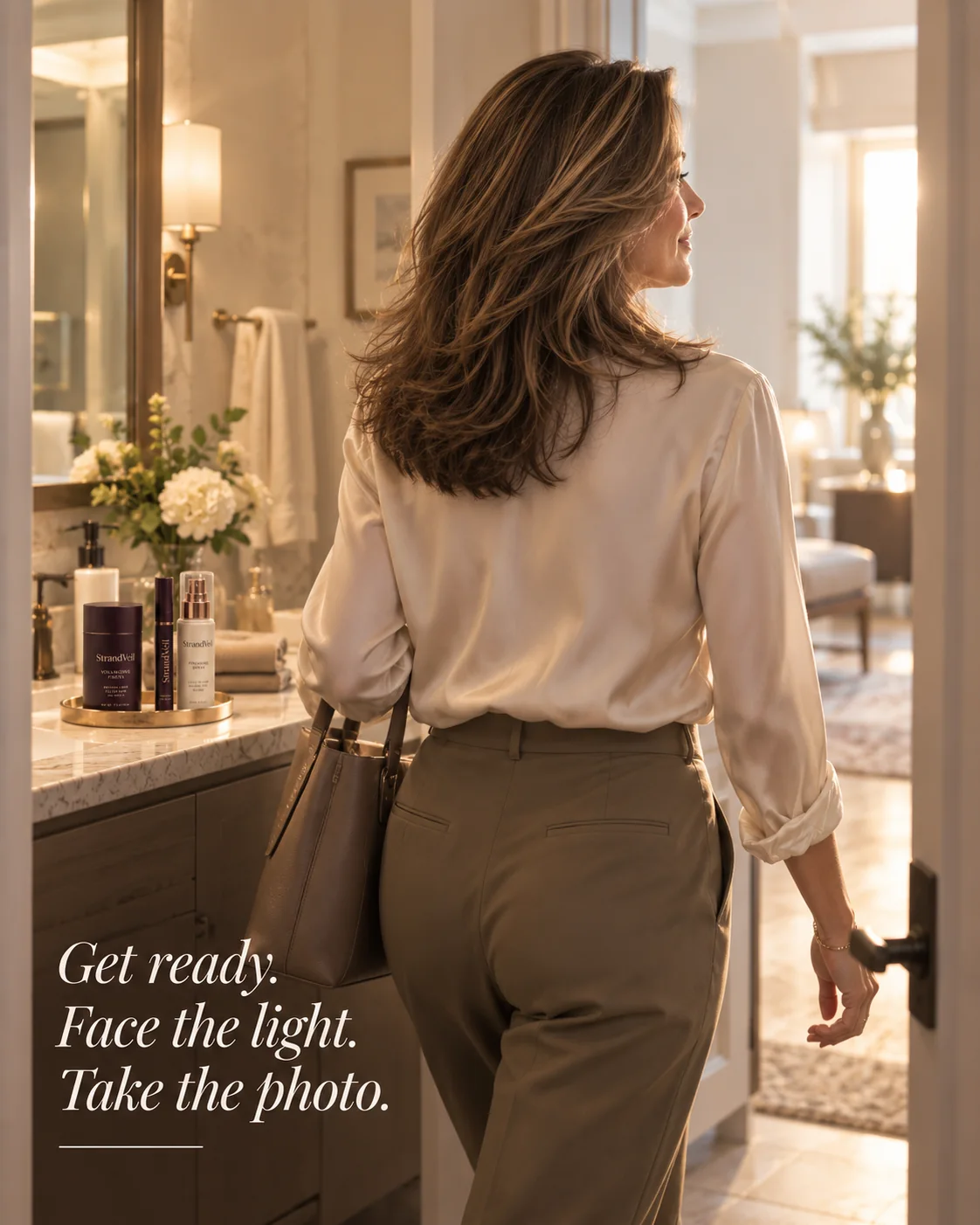
StrandVeil was positioned around that female-first use case: precision placement for a widening part or diffuse crown, hair-building fibers that cling to existing strands, and a setting step that helps finish the look.
StrandVeil
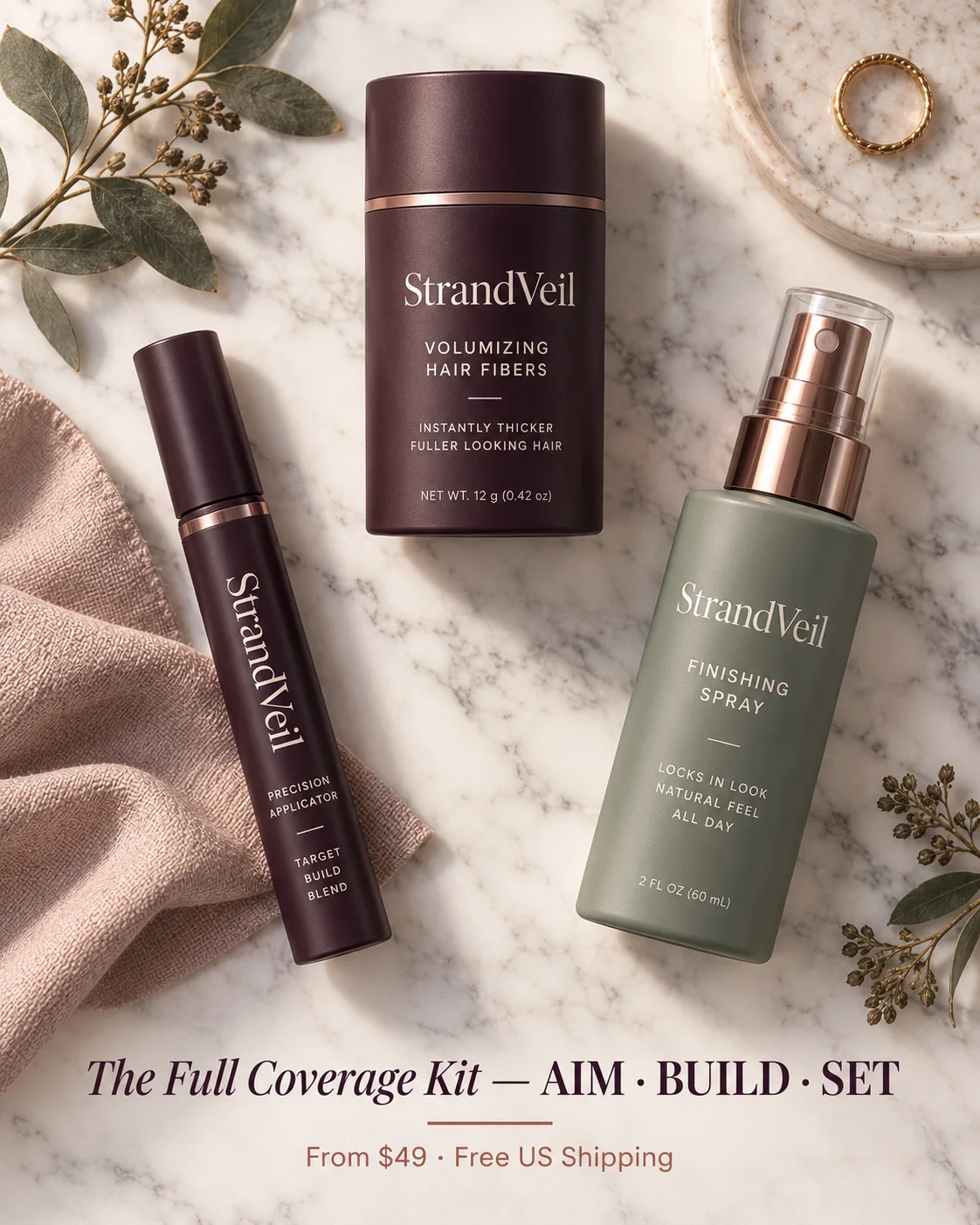
It's a Full Coverage Kit — three components designed around the specific problem we've been discussing: the widening part, the diffuse crown thinning, and the scalp-contrast gap that overhead light exposes. Not a supplement. Not a treatment. A precision cosmetic system built around immediate visual coverage, with a routine designed to take about 30 seconds once you know your application.
My test was the test I’d come to use for everything: the bathroom mirror directly under overhead light, at the angle I’d been dreading for two years.
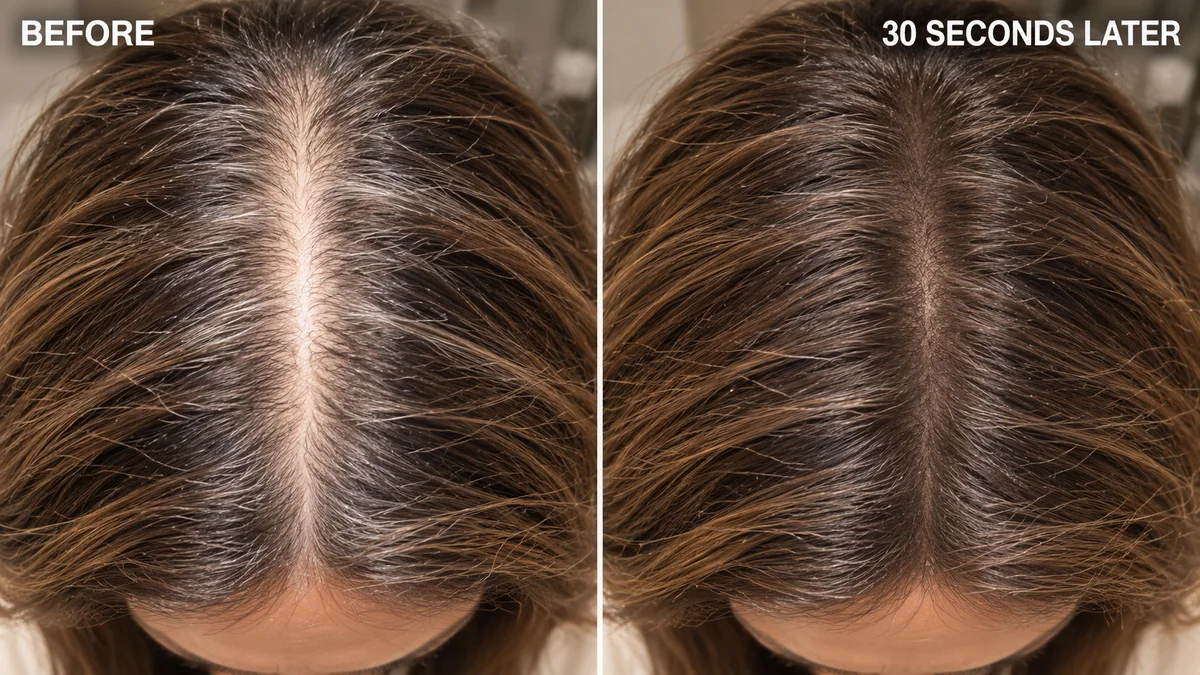
I used the applicator to target the widening part I’d been working around for months. I built one light layer of fibers. I set it. Then I looked.
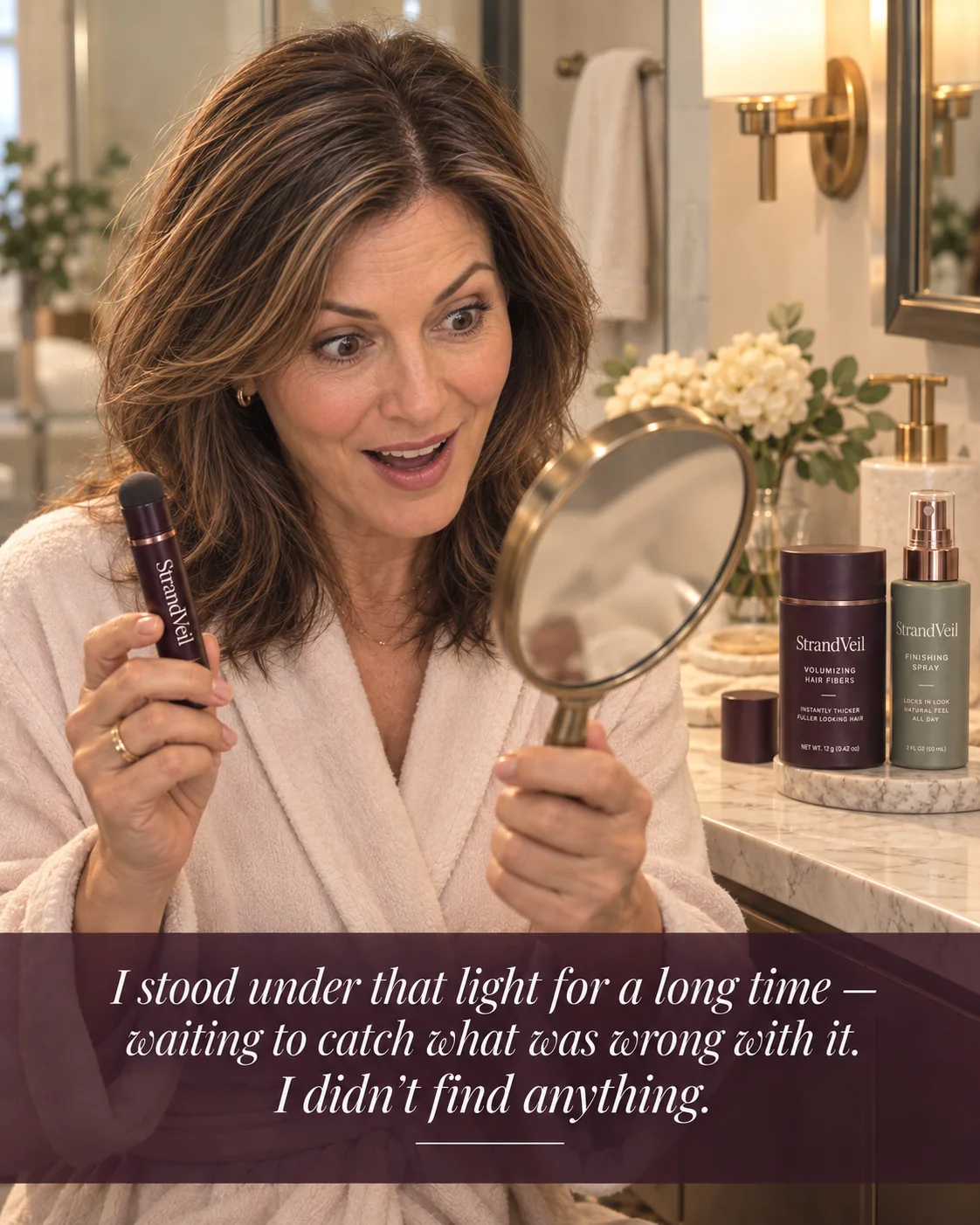
The part line was not visible in the way it had been visible. I stood under that light for a long time — not because the result was miraculous, but because I was waiting to catch the thing that was wrong with it. The powder deposit. The obvious painted line. The transfer on my fingertip when I tested it.
I didn’t find it.
Then I ran the test I’d been running after everything I’d tried. Phone camera, held overhead at the angle and distance that had been finding the gap for two years — the same geometry as a candid dinner photo, the same angle as the restaurant bathroom mirror. The gap that had appeared in every version of that photograph for two years was not in this one.
The second test was the one I'd actually been more uncertain about. Two days later: a long errand in direct sun, warm enough that I came home with my neck damp. I went straight to the bathroom. The same overhead light, the same angle.
The part looked the way it had when I left.
I was prepared to factor in that result as a good day. It happened again on the third day, and the fourth.
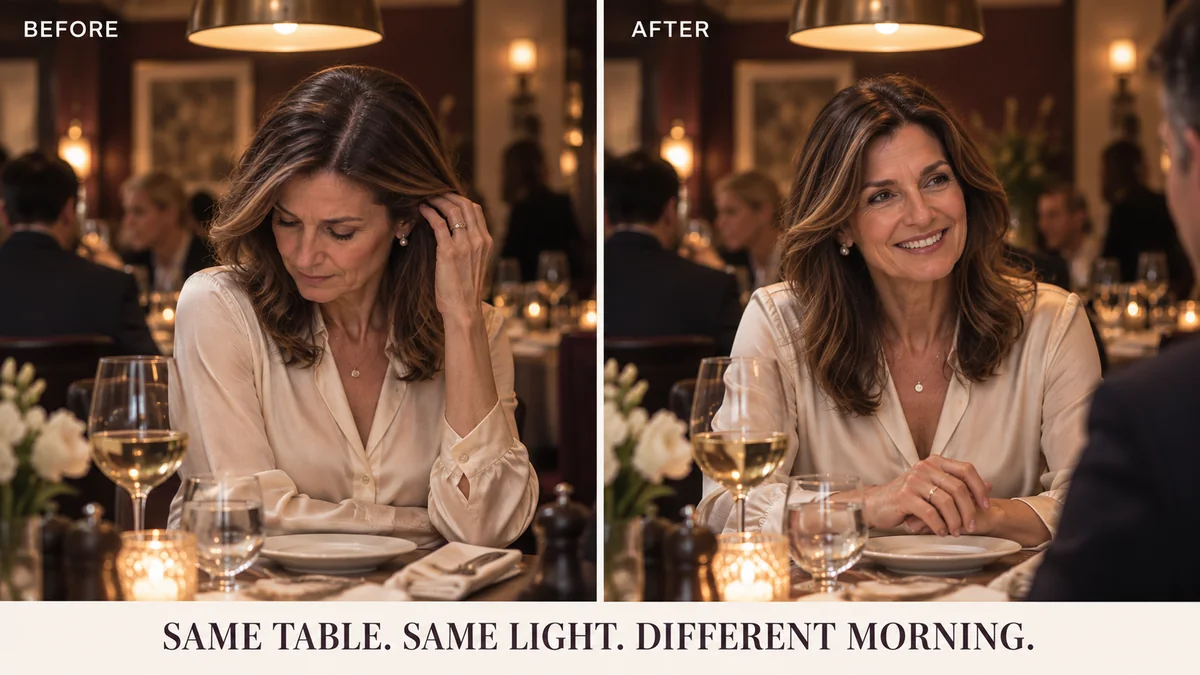
What it looked like was that my part was not something anyone was going to notice from normal social distance, under bathroom light, or in a photo. Which is exactly what I needed it to look like. Not fixed. Not restored. Just no longer the thing the light finds.
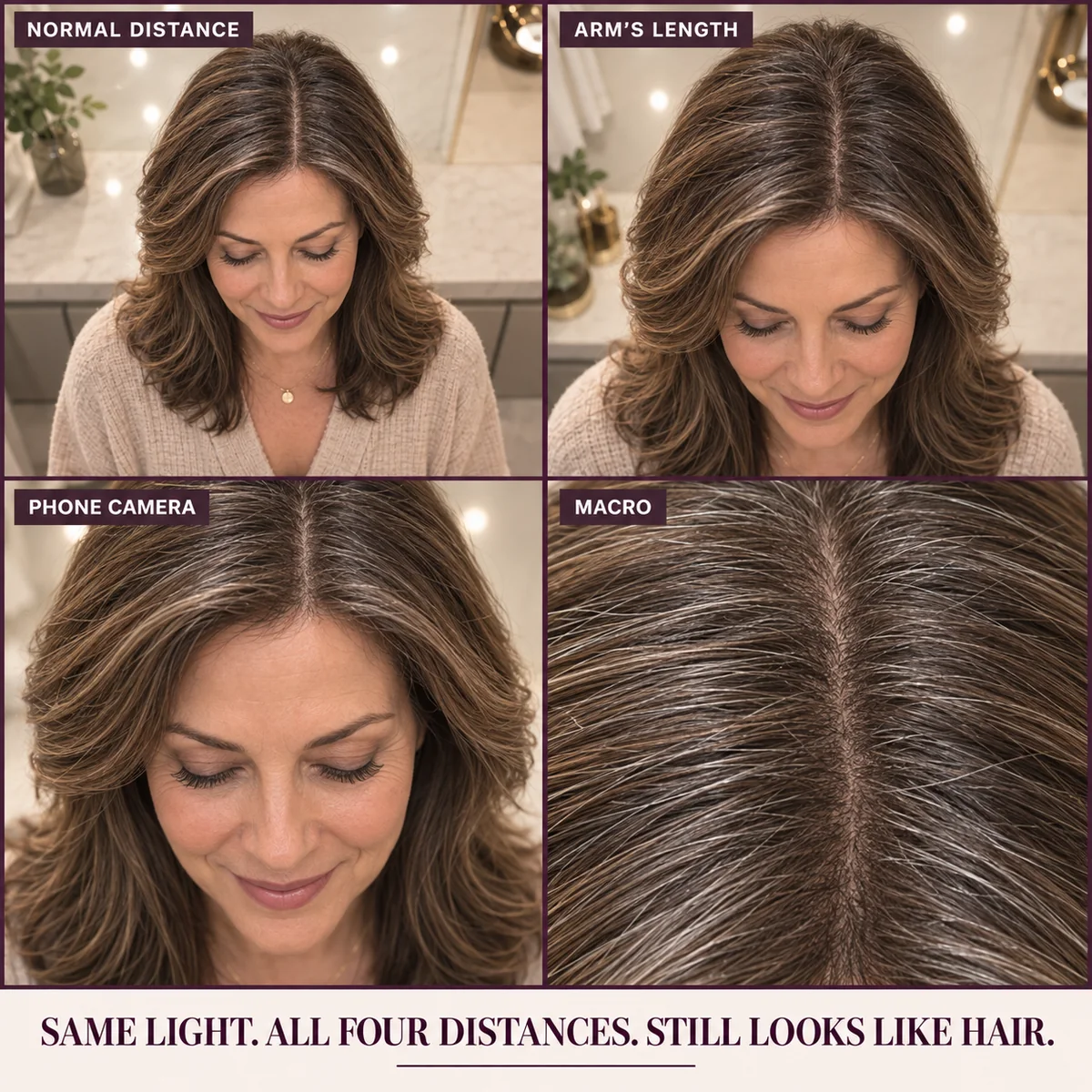
For a product like this, the standard should be simple: it has to be judged in the same conditions that make the problem feel most obvious.
That means overhead light, close phone-camera distance, controlled placement along the part, and a finish that reads as fuller-looking hair rather than pigment painted onto skin.
StrandVeil's AIM → BUILD → SET system is designed around those conditions: direct the fibers where coverage is needed, build visual density on existing strands, then use the finishing spray to help secure the finished look during normal daily wear.
The goal is not to pretend thinning never happened. It is to reduce the visible scalp contrast enough that the part stops demanding your attention every time the lighting changes.
What this kind of cosmetic control is meant to change

From women who've been using it


What's in the Full Coverage Kit — and why it's $49
The advantage is how the three steps work together. AIM controls placement. BUILD creates visible density around existing strands. SET helps secure the finished look. Remove one of those steps and you lose part of what makes the routine controlled, believable, and practical. Together, they form the complete AIM → BUILD → SET system.
At $49 for the complete kit, the comparison that matters is not simply to another bottle of fibers. Long-term supplements can add up over months, hair toppers can cost hundreds of dollars, and medical treatment has a different purpose and timeline. StrandVeil is priced as a complete cosmetic system for immediate visual control: fibers, precision application, and a setting step in one kit.
$49 gets you cosmetic control today. The comparison that matters is not to another fiber product. A month of a premium hair supplement runs $80–90, requires three to six months before any visible result, and carries no guarantee of one. A quality hair topper runs $400–700 or more, with the additional management that comes with it. Minoxidil is inexpensive, but for many women who start it, the initial shedding phase makes cosmetic coverage most important at exactly the moment biological results are still months away. A product that works this consistently becomes part of a beauty routine the way a quality concealer does — something you reach for without thinking, because it reliably does what it's supposed to do. That is the standard this is priced against — not a commodity bottle of powder.

This is one of the most common questions, and it deserves a direct answer.
Hair at this life stage is rarely one color. There's usually gray worked through it, highlights from salon color, natural variation in how the hair catches light. The concern is that one fiber shade will create an obvious flat block of color that reads as coverage rather than hair.
Two things are worth knowing. First, the way fibers work — distributed across existing strands rather than applied in a flat layer to the scalp — means the result reads as overall density at normal social distance, not as a single painted color. The variation in your existing hair provides the tonal range the eye expects. Second, shades can be layered or mixed for women with more complex coloring. A lighter shade feathered into an application of a slightly deeper one can produce a more dimensional result than a single shade alone.
If you're uncertain which shade to start with, choose the shade closest to the majority of your hair — not your gray — and build up gradually with a light first pass. You can always add; you can’t easily remove.
This is the objection that quietly stops more purchases than almost any other, and it's worth addressing without softening it.
Loose fibers without a setting step can transfer — which is exactly why the finishing spray is a step in the system, not an optional accessory. Once the spray sets, the fibers are designed to behave the way a finished, styled hair does: they move with the hair rather than shedding off it during normal daily contact.
A brief wait after applying the spray before contact with fabric — the same logic as letting a fresh coat of nail polish cure before you touch anything — is all the routine asks. After that, you're looking at the same transfer risk as a normal blowout.
One thing we'd rather say clearly than have you discover on your own: on days with unusually heavy sweat or extended contact with light-colored fabric, the finishing spray works harder than on others. Start with the expectation of a normal day, see how the hold performs for you, and adjust your use of the setting step accordingly.
StrandVeil is designed for normal daily wear after the coverage has been set. Heat and humidity vary, and heavy perspiration can make any cosmetic hair product work harder.
For warmer days, build coverage in light layers, use the setting step thoroughly, allow it to dry, and avoid rubbing the area. If conditions are unusually wet or sweaty, a quick mirror check or touch-up may be appropriate.
We do not describe the system as sweatproof or waterproof. The aim is dependable cosmetic coverage during ordinary daily conditions, with realistic expectations when moisture and friction increase.
If you've read this far, you already know. You knew before you started reading. You knew when the bathroom light found it, and when the restaurant mirror showed you something you weren't expecting, and when the photo arrived in a group text and you zoomed in before anyone else could see it.
You don't need another piece of evidence. You need permission and a path. This is both.